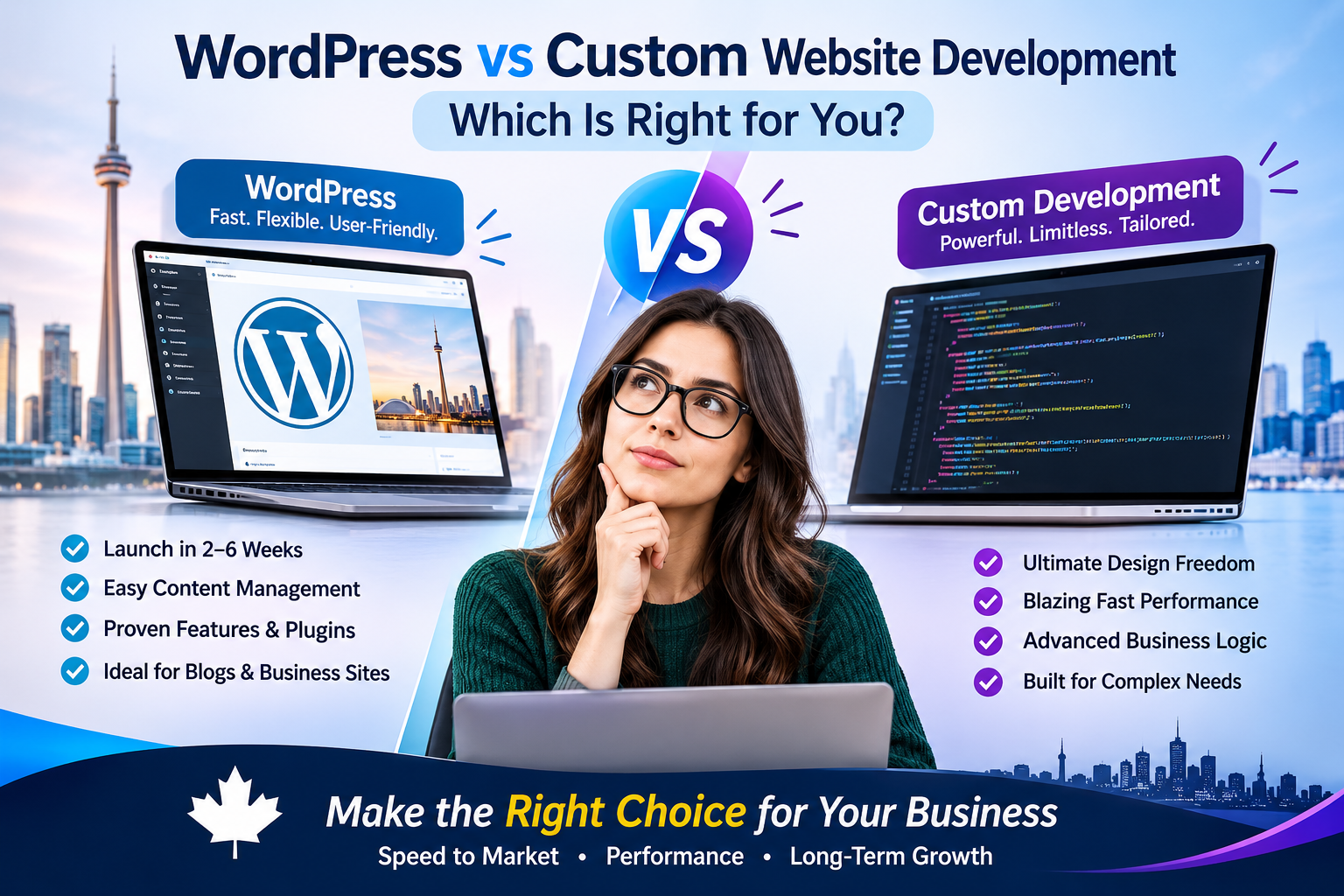
WordPress website development is the right choice if you need to launch within 2 to 6 weeks, empower a non-technical team to publish content easily, and rely on proven features for marketing or standard e-commerce. Custom web development is the right choice if your website functions as a core software product, requires proprietary business logic, demands sub-second page speeds at enterprise scale, or operates under strict compliance workflows.
Choosing between WordPress vs custom website development comes down to balancing speed-to-market against long-term architectural freedom. Powering roughly 43% of all websites globally, WordPress gives businesses a mature content management system (CMS) right out of the box. Conversely, custom web development engineered from scratch using modern frameworks like Next.js, React, Laravel, or Node.js eliminates pre-built templates and third-party plugin limits.
How Both Platforms Actually Work
What Is WordPress Website Development?
WordPress is an open-source Content Management System (CMS) built on PHP and MySQL. Rather than coding every button, database table, and login screen from zero, developers assemble your site using a foundational core, a visual theme (pre-made or bespoke), and modular plugins for features like SEO, contact forms, and online stores.
What Is Custom Web Development?
Custom web development is bespoke software engineering. Developers write clean, tailored front-end and back-end code specifically around your exact business rules. There are no generic dashboards, unused theme scripts, or third-party plugin dependencies—every interaction and database query is built strictly for your workflow.
Head-to-Head Comparison: WordPress vs. Custom Websites
| Evaluation Factor | WordPress Website Development | Custom Web Development |
| Launch Timeline | Fast (typically 2 to 6 weeks) | Longer (typically 8 to 20+ weeks) |
| Page Speed & Core Web Vitals | Strong when lean; slows down if overloaded with heavy plugins | Blazing fast (sub-second loads) with zero bloated scripts |
| Security Profile | Relies on timely core, theme, and plugin updates | High; smaller attack surface with no public plugin vulnerabilities |
| Content Editing | Intuitive block editor for non-technical marketing teams | Requires a custom-built admin panel or headless CMS setup |
| Design Freedom | Guided by theme architecture unless custom-coded | Unlimited; pixel-level control over UI, animations, and UX |
| Scalability & Features | Ideal for blogs, service sites, and standard e-commerce | Unlimited; built for complex APIs, SaaS portals, and high traffic |
Real-Life Examples: Seeing Both Choices in Action
To make the distinction concrete, compare how two different Canadian businesses solve their digital needs:
- This (WordPress Example — A Multi-Location Dental Clinic in Toronto): A growing dental practice needs an informational website with 15 service pages, a local SEO blog, dentist profiles, and an integration with their existing third-party appointment booking widget. Using WordPress website development, an agency launches a clean, mobile-friendly site in four weeks. The clinic’s office manager can publish new dental health articles and update holiday hours in minutes without ever filing a developer ticket.
- That (Custom Web Development Example — A Freight & Logistics Marketplace in Vancouver): A logistics startup needs shippers and truck drivers to create role-based accounts, calculate live fuel-adjusted freight quotes, track GPS shipments on an interactive map, and trigger automated payouts. WordPress plugins cannot safely handle real-time bidding logic or complex database queries on a scale. Custom web development provides a dedicated React front end and Node.js back end engineered specifically for high-concurrency transactions.
Key Decision Factors: This vs. That Breakdown
- Speed to Launch vs. Long-Term Flexibility
- Choose WordPress if: Your immediate goal is establishing a credible digital presence, testing a new market, or scaling an inbound content engine quickly. Because core publishing tools already exist, you avoid reinventing the wheel.
- Choose Custom if: Your website is the product. If your business model relies on custom user dashboards, multi-step calculators, or deep integrations with internal ERP and CRM software, custom architecture prevents you from hitting technical roadblocks later.
- Performance, SEO, and AI Search Visibility
- Choose WordPress if: Your organic growth depends on frequent publishing, topical authority, and local service pages. With clean semantic HTML, structured schema markup, and quality managed hosting, WordPress ranks exceptionally well in both traditional search and AI answer engines.
- Choose Custom if: Every millisecond impacts user retention and conversion rates. Custom frameworks eliminate render-blocking CSS and unnecessary JavaScript bundles, easily passing Google’s strict Interaction to Next Paint (INP) and Core Web Vitals benchmarks.
- Maintenance and Security Governance
- Choose WordPress if: You commit to routine technical upkeep. Because WordPress is the world’s most popular CMS, automated bots constantly scan for outdated plugins. Regular updates, automated backups, and strong server-level security keep risks minimal.
- Choose Custom if: You handle sensitive financial, medical, or enterprise data governed by strict Canadian privacy regulations (such as PIPEDA or PHIPA). Custom code hides standard CMS login endpoints and removes third-party plugin vulnerabilities.
Partnering with Web Development Services in Canada
Whether you lean toward a streamlined CMS build or bespoke engineering, working with experienced web development services in Canada ensures your platform aligns with local regulatory and market standards including bilingual (English and French) site architecture, AODA accessibility compliance, Canadian data residency hosting, and domestic payment gateway integrations.
A reliable Canadian development partner will guide you based on technical fit rather than pushing a one-size-fits-all stack recommending a lightweight, custom-themed WordPress build when content agility is your priority, or engineering a top custom web application when complex workflows demand it.
Making the Right Call for Your Business
The debate around WordPress vs custom website development is not about which technology is universally “better”, it is about matching your architecture to your business stage.
- Go with WordPress website development if speed-to-market, effortless content publishing, and proven marketing integrations are your top priorities.
- Go with custom web development if your digital platform requires proprietary software logic, sub-second performance at scale, or strict regulatory compliance.
Whichever route fits your roadmap, your website should never become a bottleneck to your growth. Choosing the right foundation today saves you from costly rebuilding tomorrow.
Ready to Build a Website That Scales with Your Business?
Still unsure whether a streamlined WordPress build or bespoke custom engineering is the right fit for your goals? Let our technical architects audit your requirements and map out a clear, jargon-free roadmap.
Partner with trusted web development services in Canada to turn your vision into a high-performing digital asset:
- Unbiased Technical Guidance: We recommend the exact tech stacks your business needs never over-engineering simple sites or forcing complex apps into rigid templates.
- Built for Speed, SEO & AI Search: Every site is structured for Core Web Vitals, clean semantic indexing, and maximum search visibility.
- Canadian Standards Ready: Full support for bilingual (EN/FR) architecture, AODA accessibility compliance, and local data privacy best practices.
Frequently Asked Questions
Is WordPress better than a custom website for SEO?
Neither platform holds an automatic ranking advantage in Google. WordPress makes on-page SEO accessible for non-technical teams through dedicated SEO plugins, while custom websites often achieve stronger technical SEO baselines due to cleaner code and faster mobile load speeds.
Can I switch from WordPress to a custom website later?
Yes. Many growing companies launch their initial presence on WordPress to validate market demand and build organic search authority, then migrate to a custom web application once user volume and feature complexity justify bespoke engineering.
What is Headless WordPress?
Headless WordPress is a hybrid architecture where your marketing team continues using WordPress as a familiar back-end content editor, while developers build a separate, ultra-fast custom front end (using frameworks like Next.js or React) that pulls content via an API.
Is WordPress secure enough for a business website?
Yes, when properly maintained. Because WordPress powers a massive share of the web, automated bots frequently target outdated plugins and themes. Keeping WordPress core, PHP versions, and plugins updated alongside managed hosting keeps security risks low. Custom websites reduce exposure simply because they have a smaller attack surface and do not rely on public third-party plugins.
Will a custom website be harder for my non-technical team to update?
Not if planned properly during the architecture phase. While WordPress comes with an intuitive block editor right out of the box, developers building a custom website can create a streamlined, tailored admin dashboard or connect a headless CMS so your marketing team can publish blogs, swap images, and edit pages without touching code.