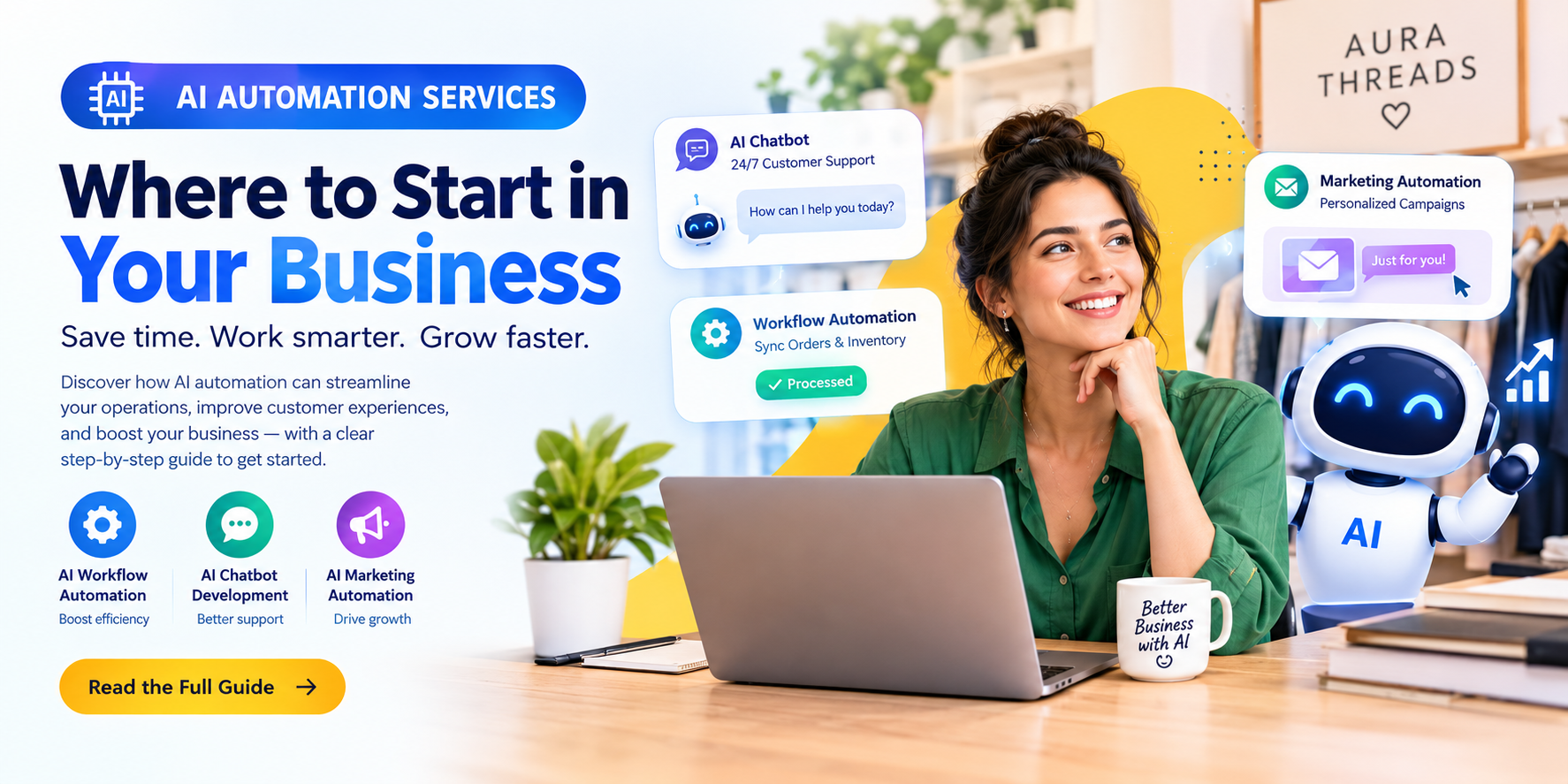
Imagine running a local retail business, say a boutique clothing store called Aura Threads. Every morning, the owner, Sarah, spends two hours manually sorting customer inquiry emails, copying order details into an inventory spreadsheet, and drafting weekly promotional emails. By the time she actually turns her focus to growing her business, half the day is gone.
Now imagine Sarah implementing a smart AI system: an intelligent online assistant answers routine customer questions 24/7, an automated workflow syncs her online orders with inventory in real time, and an AI marketing tool personalized email campaigns based on customer browsing habits. Sarah gains back 15 hours a week to focus on expansion.
This is the power of AI automation services. If you have been wondering how to leverage artificial intelligence in your company but do not know where to begin, this guide breaks down the core pillars of AI automation, compares traditional methods with modern solutions, and gives you a clear roadmap to start.
What Are AI Automation Services?
At its core, AI automation services involve integrating artificial intelligence technologies—such as machine learning, natural language processing, and smart algorithms into daily operational workflows. Unlike traditional automation, which strictly follows rigid “if-this-then-that” rules, AI-driven automation adapts, learns, and handles complex, unstructured data.
To build a strong foundation, businesses generally focus on three primary semantic clusters:
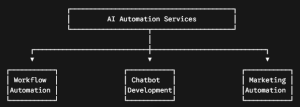
- AI Workflow Automation: Streamlining backend operations, data entry, document processing, and cross-platform syncs.
- AI Chatbot Development: Enhancing front-end customer support, lead qualification, and real-time engagement.
- AI Marketing Automation: Optimizing content delivery, audience segmentation, and ad campaign performance.
Comparing the Approaches: Traditional vs. AI-Driven Automation
To understand where to invest first, it helps to compare traditional business operations against modern AI automation services.
|
Operational Area |
Traditional / Legacy Approach | AI-Driven Automation Approach |
Key Advantage |
| Customer Support | Human agents handle all queries via email/phone with limited off-hours support. | AI Chatbot Development enables conversational bots to resolve up to 80% of routine queries instantly. | 24/7 availability and instant response times. |
| Data & Processes | Manual data entry across CRM, ERP, and spreadsheets; prone to human error. | AI Workflow Automation extracts data from invoices/emails and updates databases automatically. | Near-zero error rates and massive time savings. |
| Marketing Campaigns | Generic email blasts sent to entire contact lists at set calendar intervals. | AI Marketing Automation delivers hyper-personalized content based on user behavior in real time. | Higher conversion rates and better ROI. |
3 Essential Pillars to Start Your AI Automation Journey
- AI Workflow Automation (Backend Efficiency)
Before expanding sales or marketing, your internal operations must be seamless. AI workflow automation connects your software applications so data moves frictionlessly without human intervention.
- Real-Life Example: A logistics company receives hundreds of PDF invoices daily. Instead of an employee reading each PDF and typing values into accounting software, an AI document parser reads the invoices, extracts line items, validates totals, and posts them straight into accounting software like QuickBooks or Xero.
- AI Chatbot Development (Frontend Support & Sales)
Customer expectations for instant response times are at an all-time high. Modern AI chatbot development goes beyond old rule-based decision trees. Generative AI chatbots understand context, intent, and tone, allowing them to answer complex questions and guide prospects through sales funnels.
- Real-Life Example: An e-commerce platform integrates an AI customer assistant. When a visitor asks, “Do you have a blue denim jacket in medium that ships to Chicago by Friday?”, the chatbot checks real-time inventory, calculates shipping times, and presents a direct checkout link all in seconds.
- AI Marketing Automation (Growth & Personalization)
Marketing without AI often leads to wasted ad spend and missed opportunities. AI marketing automation analyzes customer data patterns to deliver the right message to the right audience at the exact right moment.
- Real-Life Example: A SaaS company uses AI marketing tools to track user behavior inside its app. If a trial user explores advanced reporting features three times in a week, the AI automatically triggers a tailored email campaign highlighting a case study on reporting analytics, prompting an upgrade to a premium tier.
Traditional Workflow vs. AI Automated Workflow
Here is how a typical customer onboarding process changes when moving from manual tasks to an integrated AI pipeline:
TRADITIONAL WORKFLOW:
[ Lead Fills Form ] ➔ [ Manual Email Assignment ] ➔ [ Sales Rep Responds (24 hrs) ] ➔ [ Manual CRM Entry ]
AI AUTOMATED WORKFLOW:
[ Lead Fills Form ] ➔ [ AI Scores & Enriches Lead ] ➔ [ Instant AI Chat / Email Outreach ] ➔ [ Auto Sync to CRM ]
Step-by-Step Roadmap: How to Implement AI Automation
If you are ready to introduce AI automation services into your organization, follow this practical four-step implementation plan:
Step 1: Audit Your Bottlenecks
Identify repetitive, high-volume tasks that consume employee hours. Look for processes involving:
- Data entry or copy-pasting between systems.
- High customer support ticket volumes on predictable topics.
- Routine scheduling and reporting tasks.
Step 2: Choose High-Impact, Low-Complexity Wins
Do not try to automate your entire enterprise overnight. Start with a focused pilot project:
- If support response times are slow, prioritize AI chatbot development.
- If manual data processing causes errors, focus on AI workflow automation.
- If lead conversion is sluggish, invest in AI marketing automation.
Step 3: Select the Right Tech Stack and Partners
Decide whether to build custom models, utilize no-code/low-code AI tools (like Make, Zapier, or OpenAI APIs), or hire a specialized AI automation provider to architect and maintain your systems.
Step 4: Measure, Iterate, and Scale
Establish key performance indicators (KPIs) before launching:
- Time Saved: Hours reclaimed per week per employee.
- Cost Reduction: Lower cost per ticket or operational transaction.
- Revenue Gain: Higher conversion rate from automated lead nurturing.
Conclusion: Taking Your First Step
Adopting AI automation services is no longer about staying ahead of the curve it is about keeping up with a fast-moving market. By focusing on core areas like AI workflow automation, AI chatbot development, and AI marketing automation, you can transform your business from a manual, reactive operation into an efficient, scalable engine.
Frequently Asked Questions
What are AI automation services, and how do they benefit my business?
AI automation services integrate artificial intelligence technologies such as machine learning and natural language processing into daily business tasks. Unlike traditional software that relies on strict rules, AI learns and adapts to complex data, helping businesses save time, reduce human errors, lower operational costs, and scale efficiently.
Where should a small business start with AI automation?
The best starting point is to identify your biggest operational bottleneck. Start small with a high-impact, low-complexity project:
- Customer Service: Build an AI chatbot to handle routine inquiries.
- Operations: Use AI workflow automation for manual data entry or invoice processing.
- Sales & Marketing: Implement AI marketing automation for targeted lead nurturing.
What is the difference between traditional automation and AI automation?
Traditional automation follows rigid, pre-programmed rules (e.g., “if X happens, do Y”) and fails when encountering unexpected data. AI automation can process unstructured information such as customer emails, scanned documents, or natural language questions making intelligent decisions and continuously improving over time.
How long does it take to implement AI automation services?
Simple AI implementations, such as no-code workflow automations or out-of-the-box customer service chatbots, can be set up in a few days to a few weeks. More complex, custom enterprise integrations typically take 1 to 3 months depending on data requirements and system architecture.
Do I need technical or coding skills to use AI automation tools?
No. Many modern AI automation platforms offer user-friendly, no-code/low-code interfaces. However, for custom integrations, advanced security, or scaling across multiple enterprise systems, partnering with specialized AI automation service providers is recommended.