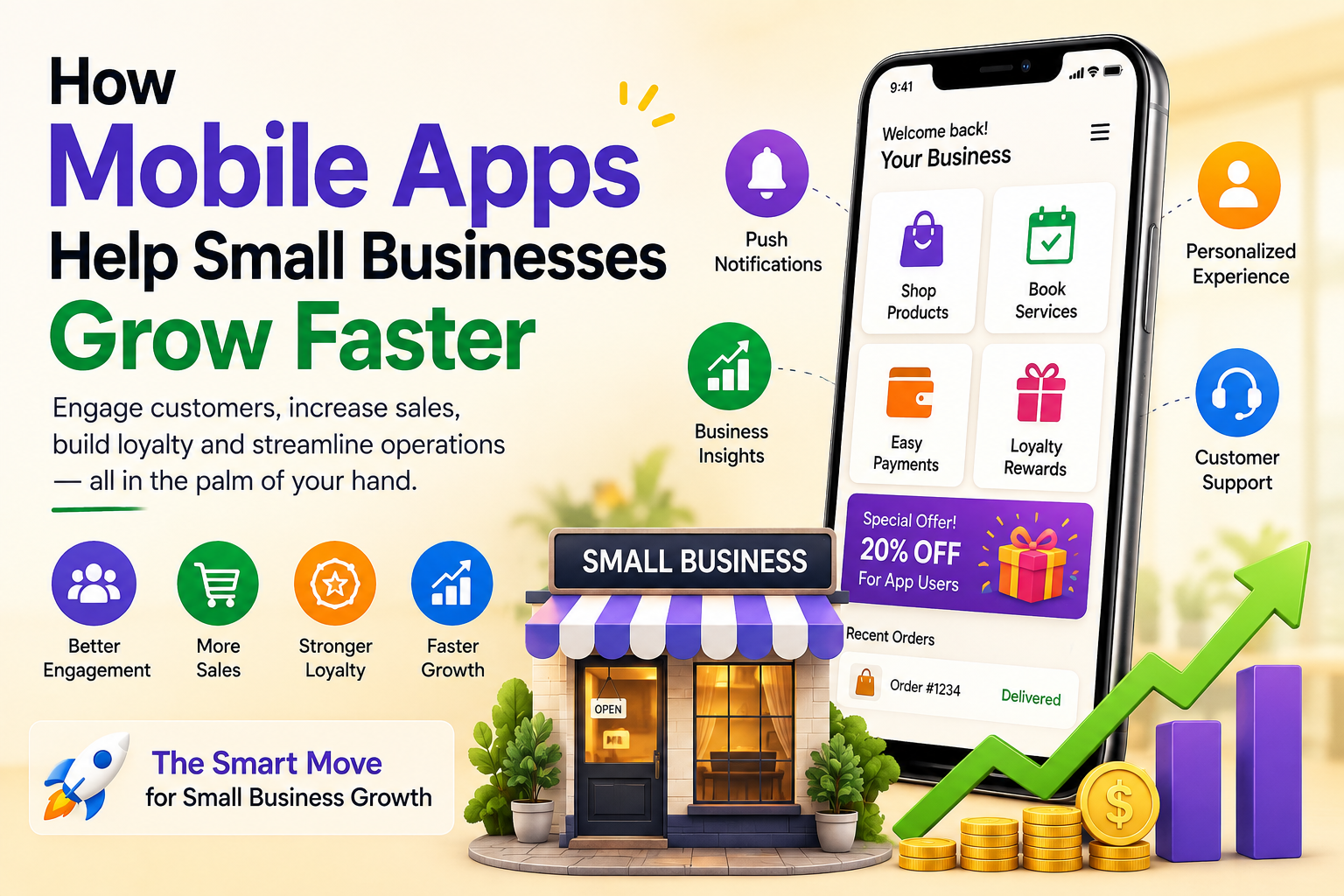
Small businesses need more than a good product or service to grow in a competitive digital market. They also need convenient ways to attract customers, build relationships, increase sales, and keep people coming back.
This is where mobile apps can make a difference.
A well-designed mobile app can give a small business a direct connection with its customers. It can simplify ordering, booking, payments, customer support, loyalty programs, and other everyday interactions.
But having an app is not automatically a growth strategy. The real value comes from building an app around a genuine customer need or business problem.
In this guide, we will explore how mobile apps help small businesses grow faster, what features matter most, when custom mobile app development makes sense, and how businesses can choose between native and cross-platform development.
Key Takeaways
- Mobile apps can create a direct communication channel between businesses and customers.
- Apps can make purchasing, booking, and customer service more convenient.
- Loyalty programs and personalized experiences can encourage repeat business.
- Mobile apps can automate repetitive tasks and improve operational efficiency.
- Custom mobile app development allows businesses to build features around their specific needs.
- iOS and Android app development can help businesses reach customers across major mobile platforms.
- Cross platform mobile app development can be useful when businesses want to support multiple platforms from a shared development approach.
- The best app is not necessarily the one with the most features; it is the one that solves the right problem.
Why Are Mobile Apps Important for Small Businesses?
Customers increasingly expect businesses to provide convenient digital experiences.
People use their phones to search for products, compare services, make purchases, book appointments, communicate with businesses, and manage payments.
A mobile app can bring several of these activities into one place.
For a small business, this can create opportunities to improve both customer experience and business operations.
For example, a restaurant could allow customers to:
- Browse the menu.
- Place an order.
- Pay through the app.
- Receive order updates.
- Earn loyalty points.
- Receive relevant offers.
Instead of relying on several disconnected channels, the business can provide a more connected customer journey.
7 Ways Mobile Apps Help Small Businesses Grow Faster
1. Mobile Apps Create a Direct Customer Connection
Social media platforms and search engines are useful for attracting customers, but businesses do not have complete control over those platforms.
A mobile app creates another direct channel between a business and its customers.
Businesses can use apps to provide:
- Order updates
- Appointment reminders
- Loyalty rewards
- New product announcements
- Personalized offers
- Customer support
- Important service notifications
This direct relationship can help businesses stay connected with existing customers.
Why this matters for growth
Customer acquisition is important, but retaining existing customers can also contribute significantly to sustainable growth.
An app gives businesses another way to encourage customers to return without requiring them to search for the business again.
2. Apps Make Buying and Booking More Convenient
Convenience is one of the strongest reasons customers use mobile apps.
If a customer can complete a task in a few simple steps, they may be more likely to finish it.
A mobile app can simplify:
- Product purchases
- Food ordering
- Appointment booking
- Service requests
- Payments
- Delivery tracking
- Subscription management
For example, a cleaning company could allow customers to select a service, choose a date, pay online, and receive appointment reminders through an app.
The customer gets a simpler experience, while the business gets a more organized process.
3. Mobile Apps Can Increase Customer Retention
Getting customers to make their first purchase is only one part of business growth.
Businesses also need to give customers reasons to return.
Mobile apps can support retention through features such as:
Loyalty programs
Customers can earn points, unlock rewards, or receive member benefits.
Personalized offers
Businesses can provide promotions based on relevant customer behavior.
Easy repeat purchases
Customers may not need to repeatedly enter the same information when ordering again.
Notifications
Businesses can send useful reminders about orders, appointments, rewards, or new services.
The key is relevance.
Sending too many notifications can frustrate users, while useful and timely notifications can improve the customer experience.
4. Apps Can Help Small Businesses Increase Sales
A mobile app can create another sales channel for a business.
Depending on the business model, an app can support:
- Product sales
- Service bookings
- Subscriptions
- Memberships
- Upselling
- Cross-selling
- Special promotions
- Personalized recommendations
For example, an online retailer could recommend related products after a customer adds an item to the cart.
A fitness business could offer premium memberships through its app.
A restaurant could promote relevant add-ons during checkout.
The goal should be to make useful recommendations rather than overwhelm customers with promotions.
5. Mobile Apps Can Improve Customer Service
Customers want quick answers and convenient support.
A mobile app can bring customer service tools into the same environment where customers already interact with the business.
Depending on the business, this could include:
- Live chat
- FAQs
- Support requests
- Order tracking
- Booking changes
- Notifications
- Contact options
For example, an ecommerce customer could check an order’s status without calling customer support.
This can reduce unnecessary communication while giving customers more control.
6. Apps Can Automate Repetitive Business Processes
Mobile apps are not only useful for customers.
They can also help businesses automate repetitive tasks.
Consider an appointment-based business.
Without an app:
Customer calls → Employee checks availability → Appointment is recorded → Confirmation is sent → Reminder is sent manually
With a well-integrated app:
Customer selects service → Chooses available time → Confirms booking → Automatic confirmation → Automatic reminder
The exact benefits depend on the business, but automation can reduce manual work and allow employees to focus on more important tasks.
7. Mobile Apps Provide Useful Business Insights
An app can generate data that helps businesses understand customer behavior.
Businesses may be able to analyze:
- Popular products
- Frequently booked services
- Repeat purchases
- Customer engagement
- App feature usage
- Conversion rates
- Cart abandonment
- Notification engagement
These insights can help business owners make better decisions.
For example, if many users add a product to their cart but do not complete checkout, the business can investigate whether the checkout process is too complicated.
Data should be collected and used responsibly, with appropriate privacy and security practices.
What Features Should a Small Business Mobile App Have?
There is no universal list of features that every business needs.
The right features depend on the company’s customers, business model, and goals.
However, many small business apps can benefit from:
- User accounts
- Product or service catalogs
- Online payments
- Booking
- Push notifications
- Loyalty programs
- Customer support
- Order tracking
- Reviews and feedback
- Analytics
- Admin dashboards
The best approach is to prioritize features according to business value.
A simple application that solves one important problem can be more successful than a complicated app with dozens of unnecessary features.
Custom Mobile App Development: Why It Matters
Custom mobile app development allows a business to build an application around its own requirements.
Instead of adapting business processes to a generic application, the company can create workflows specifically for its customers and employees.
For example, a custom app could connect:
Customer → Mobile App → Payment System → Business Database → Admin Dashboard
This type of integration can make the app more than just a customer-facing interface.
It can become part of the company’s broader digital infrastructure.
When Does Custom App Development Make Sense?
Custom development can be worth considering when a business needs:
- Unique functionality
- Custom workflows
- Third-party integrations
- Specialized customer experiences
- Advanced analytics
- Business-specific automation
- Integration with existing systems
However, custom development can require more planning, development, testing, and maintenance than using an off-the-shelf solution.
The decision should therefore be based on business requirements rather than simply choosing the most advanced technology.
iOS and Android App Development: What Should Businesses Choose?
Businesses often need to decide whether they should build for iOS, Android, or both.
iOS and Android app development can help a company reach customers across the two major mobile ecosystems.
The right choice depends on the target audience.
For example, if most of a company’s existing customers use iPhones, launching on iOS first may make sense.
If the customer base is spread across different devices, supporting both platforms may be more appropriate.
Before choosing a platform, businesses should consider:
- Target audience
- Device usage
- Required features
- Budget
- Development timeline
- Long-term maintenance
Native vs. Cross Platform Mobile App Development
There are several ways to build a mobile application.
Native development focuses on building specifically for a particular platform, while cross platform mobile app development can allow developers to create applications for multiple platforms using a shared development approach.
Simple Comparison
| Factor | Native Development | Cross-Platform Development |
| Platform focus | Usually one platform at a time | Multiple platforms |
| Code sharing | Limited | Greater potential for code sharing |
| Platform-specific optimization | Strong | Depends on framework and implementation |
| Development approach | Platform-specific | Shared approach across platforms |
| Best fit | Apps needing deep platform-specific functionality | Businesses seeking multi-platform coverage efficiently |
Neither approach is automatically better.
A business should consider its target users, app functionality, performance requirements, budget, and long-term plans before deciding.
How to Choose the Right Mobile App Development Approach
A useful decision process is to start with the business rather than the technology.
Ask these questions:
- Who will use the app?
Understand the target customers and the devices they use.
- What problem will the app solve?
A clear problem makes it easier to decide which features are actually necessary.
- Which platforms matter?
Look at your existing audience rather than making assumptions.
- Does the app need platform-specific capabilities?
Some applications benefit from deeper platform integration.
- What is the long-term budget?
Do not only consider the initial development cost.
Also consider:
- Maintenance
- Updates
- Security
- Hosting
- Third-party services
- Future features
Mobile App vs. Mobile Website for Small Businesses
A mobile website and a mobile app serve different purposes.
A website is often better for discoverability because new customers can find it through search engines without installing anything.
An app can be more useful for repeat engagement, especially when customers regularly purchase, book, interact, or use personalized services.
| Mobile Website | Mobile App |
| Good for discovery | Good for repeat engagement |
| Easy to access | Requires installation |
| Strong for search visibility | Strong for personalized experiences |
| Useful for new visitors | Useful for returning customers |
| Usually simpler to launch | Can provide deeper device integration |
For many small businesses, the best strategy is not choosing one over the other.
The website can attract new customers, while the app can help retain and serve existing customers.
How Much Does It Cost to Build a Mobile App for a Small Business?
There is no single price for mobile app development.
The cost can vary based on:
- Number of platforms
- App complexity
- Number of features
- UI/UX design
- Backend development
- Payment integration
- Third-party integrations
- Security requirements
- Testing
- Maintenance
A basic business app may require significantly less investment than a marketplace, financial application, or complex on-demand platform.
Instead of focusing only on the initial development price, businesses should consider the potential return.
For example:
Development investment → Better customer experience → More conversions → More repeat customers → Potential long-term business value
The actual return will depend on the business model and execution.
How to Build a Mobile App for a Small Business
A successful mobile app project should follow a clear process.
Step 1: Define the Business Goal
Decide what the app should accomplish.
Examples:
- Increase repeat purchases
- Generate more bookings
- Improve customer service
- Automate manual processes
- Increase customer loyalty
Step 2: Research the Target Audience
Understand:
- Customer needs
- Device preferences
- Common frustrations
- Buying behavior
- Existing customer journey
Step 3: Define the Minimum Viable Product
Start with the most important features.
Avoid building unnecessary functionality before validating the core idea.
Step 4: Select the Development Approach
Choose between appropriate native or cross-platform strategies based on the business requirements.
Step 5: Design the User Experience
Keep the interface simple.
Users should be able to understand the primary action quickly.
Step 6: Develop and Test
Test the application across relevant devices and real-world scenarios.
Pay particular attention to:
- Login
- Payments
- Navigation
- Forms
- Notifications
- Performance
- Security
Step 7: Launch and Improve
App development does not end at launch.
Monitor user feedback and analytics, fix problems, and continuously improve the experience.
How Do You Measure Whether a Business App Is Successful?
Downloads alone do not tell the full story.
Businesses should track metrics connected to their actual objectives.
Useful metrics can include:
App retention
How many users continue using the application?
Conversion rate
How many users complete a desired action?
Repeat purchases
Are customers purchasing more frequently?
Average order value
Is the average transaction increasing?
Booking completion
How many users complete the booking process?
Customer lifetime value
Does app engagement contribute to stronger customer relationships?
Return on investment
Does the value generated by the application justify its development and operating costs?
The most important metrics depend on the business goal.
Common Mobile App Mistakes Small Businesses Should Avoid
Building an App Without a Clear Purpose
An application needs a compelling reason for customers to use it.
Adding Too Many Features
More features can create complexity and increase development costs.
Start with the features that solve the most important problem.
Ignoring User Experience
A slow or confusing application can damage customer satisfaction.
Neglecting Maintenance
Mobile operating systems, devices, security requirements, and customer expectations change over time.
An app needs ongoing maintenance.
Overusing Push Notifications
Notifications should be useful and relevant.
Too many messages can cause users to disable notifications or stop using the application.
The Future of Mobile Apps for Small Businesses
Mobile apps are becoming increasingly connected with payments, customer relationship management, analytics, automation, loyalty programs, and other business systems.
For small businesses, this creates an opportunity to compete through convenience and personalization rather than simply trying to match larger companies feature for feature.
The most successful applications will not necessarily be the most complicated.
They will be the ones that solve meaningful problems for customers and create measurable value for the business.
Final Thoughts
Mobile apps can help small businesses grow by improving customer engagement, increasing convenience, supporting repeat purchases, automating repetitive tasks, and providing valuable customer insights.
But an app should not be built simply because mobile technology is popular.
The better approach is to start with a business problem.
Once the problem is clear, a company can decide whether custom mobile app development, iOS and Android app development, or cross platform mobile app development is the right solution.
The goal is simple:
Build an app that makes something easier for customers and creates measurable value for the business.
Contact Us.. Have an app idea for your business? Talk to our mobile app development team to explore the right approach for your goals.
Frequently Asked Questions
Is a mobile app worth it for a small business?
A mobile app can be worthwhile when customers frequently interact with the business and the application solves a genuine customer or operational problem. Businesses should evaluate the potential value before investing in development.
What is custom mobile app development?
Custom mobile app development involves creating an application specifically around a business’s requirements, customers, workflows, features, and integrations rather than relying entirely on a generic solution.
What is cross platform mobile app development?
Cross platform mobile app development is an approach that allows applications to be developed for multiple platforms using a shared development strategy or codebase, depending on the technology used.
Should a small business develop for iOS and Android?
The decision depends on the business’s target audience, customer device usage, functionality requirements, budget, and long-term strategy. Some businesses may start with one platform, while others benefit from supporting both.
How much does it cost to develop a mobile app?
The cost depends on factors such as app complexity, features, platforms, integrations, design, testing, security, and ongoing maintenance. There is no single price that applies to every small business app.